

I wrote a longer version of this piece during my MBA to critique the Dreamcast purely from a Marketing perspective. It was interesting to examine the past and appreciation the time when console was first released; I re-visited some of the information recently as I ponder whether you feel this console could be revived?
A Background to Sega
The Sega Corporation originated in America had a long historical timeline within gaming. They dominated the arcade market, starting in the form of coin-operated machines and pinball devices in the 1950s at which point the company was known as Service Games. The name was shortened to Sega at the time of merger and acquisition with Rosen Enterprise in conjunction with a transition to Japan (Blackwell et al., 2004). Sega entered the home entertainment gaming arena in 1983 with the SG-1000, which performed poorly in sales and presence against competitor Nintendo Entertainment System (NES) who had a monopolistic 90% market share (Pettus, 2013, (Horowitz, 2016:3). It took another two systems, the Master System and Sega Mega Drive in 1990 before any momentum and brand were truly reflected in sales. Many other milestones of innovation followed with the release of the Game Gear one year later and the infamous creation of Sonic the Hedgehog as a mascot to the system to rival Nintendo’s Super Mario Brothers (Moore, 2008). Unfortunately, the success was not long-lasting despite Sega finding the U.K market to be the most profitable within Europe. As with the earlier systems, Sega Saturn and Sega CD; the Dreamcast also did not reach expectations.
The Dreamcast was planned for a European release date on 14th October 1999. It is fair to say that the Sega Dreamcast had a limited lifespan for a gaming console reaching 19 months in totality. It resulted in not only Sega officially withdrawing the product at this point but was the announcement of the Sega’s decision to exit from the hardware gaming industry globally (Lachel, 2014).
Although, the Dreamcast product had a short lifecycle, the investment in marketing was present, with a strong marketing mix, competitive pricing and investment into differing customer touchpoints (Lowrey et al., 2005). Yassini et al., (2003) encapsulated Dreamcast as a product before its time. Considering this and the success of the Mega-Drive, the marketing failures of the Dreamcast require a prospective autopsy to hypothesise what may have gone wrong (Babb and Terry, 2013).
Lack of launch organisation
The Dreamcast Magazine was a popular medium for the industry at the time rivaling others such as, PC Gamer, The Edge and Official PlayStation Magazine (Yin-Poole, 2016). Looking retrospectively at the UK launch from this Magazine indicates numerous pushbacks in the European release date much to the annoyance of the editor. The editor quotes the disorganisation in the communications arriving on the day of print which led to the magazine posting incorrect release dates and quotes disappointment in the notice of three weeks delay from the viewpoint of the customer trying to place pre-orders. Although no official notification from Sega was made, the delay was presumed to be due to internet product compatibility issues with British Telecom (BT) (Rogers, 1999).
In hindsight, the release launch was also problematic as it was sandwiched to be released in between two of the most successful gaming consoles of all time the Sony PlayStation (PS1) and PlayStation Two (PS2) during which period Sega had dropped to just three percent market share (Mintel, 2000). To make matters worse, the Dreamcast was seen to be on the back foot due to sales from the preceding console, the Sega Saturn versus the PS1. This may reflect some business decisions which were beyond marketing control which may have limited the communications from Sega regarding the launch process needed for product commercialisation (Di Benedetto, 2003; Snow et al., 2011), Pettus, (2013). When making parallels to Sony Playstation at the time of release, there appeared an over emphasis upon the product features rather than gaming experience that the Dreamcast could have provided. It begs the question as to whether the innovation of the Dreamcast and the product innovations it had was before its time?
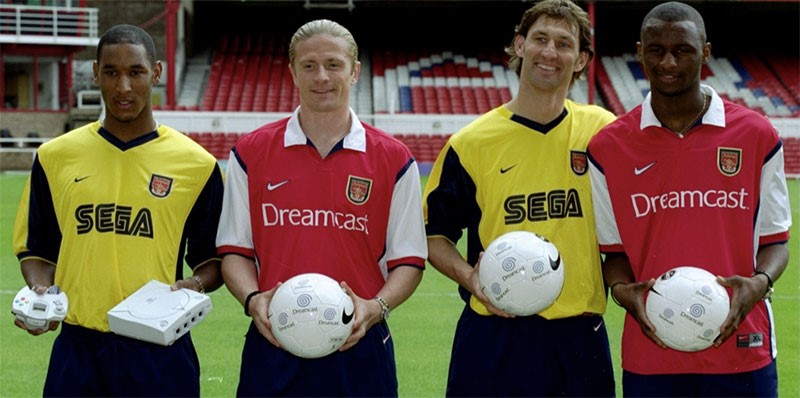
It was interesting using back editions of The Edge and other prominent gaming magazines which really conveyed the annoyance from some Editors in the ever-changing launch date. It seemed this impacted on the pre-ordering system in the U.K specifically was partly attributed to issues from suppliers involved in the connectivity of promised internet style player connectivity. I explored some of the advertising investments and remember the grungy- style TV adverts, and confusing swirl logo which did not provide much backstory to the genius of the product itself. Again within the U.K, Arsenal’s football shirts were emblazoned with Sega or Dreamcast and the marketing release shown them holding footballs in what was etched with the the swirl logo likened to the “cinnabon whirl”. It feels a shame they did not endorse a Sonic character like JEF United Chiba Japan shirts as the logo which was reported as a successful marketing campaign unlike the Dreamcast name was not well explained at the time. There was limited coining of logo to the new console to understand the relevance of the “swirl” for the launch. In an interview with the Head of Advertisement for Sega American, the swirl design was equated to a cinnamon bun showing its absence of relevance and congruence to the product (Charnock, 2015). It seemed a shame the advertising did not have time to provide a clearer backstory and exploit Sega’s arcade successes providing the experiential feel of the arcade in the convenience of home.
It is hard not to make comparisons to the Sony Playstation’s well defined “Surveytainment” market research which tailored the advertising to all members of the whole family. This could be likened to the teachings of Belk, (1988) in the notion of the gaming console becoming “an extension of the self”. It feels Sega had all the innovation there but was on the backfoot in terms of the timing of the launch against Sony which was dominating at the time.
As just one example the Playstation One focused upon parental/guardian advertising by addressing what was felt important to have at the time; (to own a DVD player) offering a 2 in 1 DVD and Console ownership (Gilmore and Pine, 2007, Gibson, 2018). In comparison, the Dreamcast appeared to be focused on new product designs, which can be commended for inspiring innovation e.g. fishing rods and wifi gaming, however, the marketing aspect and availability of such features, did not follow through with global distribution in the UK resulted in fans being unable to purchase the Bass Fishing or Dreamcast Maracas (Webber, 2014).
In later advertisement campaigns, Sony moved to the mainstream audience by offering both social “lounge suitable” features such as gaming mats, to gain parental buy-in and games for older audiences with mature content and deeper graphical interfaces. This was to ensure the product had an organic life in the hope to retain the initial children throughout their lifespan providing more social gaming and mainstream offerings (Nair et al., 2017; Sun et al., 2016).
From this assessment it does feel that the Dreamcast was unfortunate to be placed between the two well-selling consoles from Sony with a huge marketshare from both PS1 and PS2.
Lessons learnt
Although as the saying goes, hindsight is 20-20, there were lessons to be learnt and benefits from viewing Sony as a benchmark in where it got things right such as the clear pitching to developers, and effective advertisement. Additionally, it does not feel that the Dreamcast is dead. Despite being over 20 years old it also still retains a cult following. The fan base remains interested in the accessories and online capabilities this platform offered. This could be strengthened if Sega planned to return to the hardware market with the aim to bring the Dreamcast back to the niche and eventual mainstream markets through networking capabilities.
Maybe it’s the rose-tinted glasses, the “rosy retrospection” but the reason I critique the Dreamcast so intently is the believe that this system was ahead of its time. The fan following hold the hope of a re-birth wishing to re-kindle this console in the near future and allow Sega to unleash the full potential of the product and bring the Dreamcast finally to its appropriate place within the mainstream (Dreamcast-Talk, 2020; Fenlon, 2017) and it would be interesting to find out if this is also your perspective?
Referencing
Babb, J., and Terry, N. (2013) Comparing gaming sales by gaming platform. Southwestern Economic Review 40 25–40
Belk, R. W. (1988) Possessions and the Extended Self. Journal of Consumer Research 15, (2) 139–168. https://doi.org/10.1086/209154
Blackwell, R., Stephan, K., and Stephan, T. (2004) Brands That Rock: What Business Leaders Can Learn from the World of Rock and Roll. John Wiley & Sons
Charnock, T. (2015) The Beautiful Game. Available at: http://www.thedreamcastjunkyard.co.uk/2015/05/the-beautiful-game.html
Di Benedetto, C. A. (2003) Identifying the Key Success Factors in New Product Launch. Journal of Product Innovation Management – Wiley Online Library 16, (6) 530–544
Dreamcast-Talk (2020) Dreamcast-Talk.com – Forums. Available at: https://dreamcast-talk.com/forum/index.php
Frels, J. K., Shervani, T., and Srivastava, R. K. (2003) The Integrated Networks Model: Explaining Resource Allocations in Network Markets. Journal of Marketing 67, (1) 29–45. https://doi.org/10.1509/jmkg.67.1.29.18586
Gilmore, J. H., and Pine, B. J. (2007) Authenticity: what consumers really want. Boston, Mass: Harvard Business School Press
Horowitz, K. (2016) Playing at the next level: a history of American Sega games. Jefferson, North Carolina: McFarland & Company, Inc., Publishers
Lachel, C. (2014) Before Dreamcast: Cracking Sega’s Cryptic Marketing Campaign – Defunct Games. Defunct Games. Available at: http://www.defunctgames.com/commercialbreak/58/before-dreamcast-cracking-segas-cryptic-marketing-campaign
Mintel (2000) In-home Entertainment Retailing – UK – September 2000 – Market Research Report. Available at: http://reports.mintel.com/display/592/?__cc=1#
Moore, M. (2008/21/October) Sonic the Hedgehog voted favourite computer game star. Available at: https://www.telegraph.co.uk/news/3233211/Sonic-the-Hedgehog-voted-favourite-computer-game-star.html
Nair, H. S., Misra, S., Hornbuckle, W. J., Mishra, R., and Acharya, A. (2017) Big Data and Marketing Analytics in Gaming: Combining Empirical Models and Field Experimentation. Marketing Science 36, (5) 699–725. https://doi.org/10.1287/mksc.2017.1039
Pettus, S. (2013) Service games: the rise and fall of SEGA. U.st.: CreateSpace Independent Publishing Platform
Richter, F. (/2013) Infographic: Farewell Playstation 2 – Best-Selling Console of All Time. Statista Infographics. Available at: https://www-statista-com.winchester.idm.oclc.org/chart/937/best-selling-video-game-home-consoles/
Sun, L., Rajiv, S., and Chu, J. (2016) Beyond the more the merrier: The variety effect and consumer heterogeneity in system markets – ScienceDirect. International Journal of Research in Marketing, 22, (2) 261–275
Biblio
Ritzer, G. (2015) The “New” World of Prosumption: Evolution, “Return of the Same,” or Revolution? Sociological Forum 30, (1) 1–17. https://doi.org/10.1111/socf.12142
Rogers, N. (1999) Why don’t we play together? Dreamcast Magazine (02)
Rosier, B. (/2000) Brand Health Check: Sega – Will new arrivals mean game over for Sega? With PlayStation2 and next year planned launches of the X-box from Microsoft and Nintendo, Gamecube, Sega’s marketing must refocus. Campaign Live. Available at: https://www.campaignlive.co.uk/article/brand-health-check-sega-will-new-arrivals-mean-game-over-sega-playstation2-next-year-s-planned-launches-x-box-microsoft-nintendo-s-gamecube-sega-s/56569. [Accessed 12 November 2018]
Rosson, P. (2001) Football Shirt Sponsorships: SEGA Europe and Arsenal FC. International Journal of Sports Marketing and Sponsorship 3, (2) 28–54. https://doi.org/10.1108/IJSMS-03-02-2001-B005 Sega Retro (/2018) History of the Sega Dreamcast/Release – Sega Retro. Available at: https://segaretro.org/History_of_the_Sega_Dreamcast/Release.
Smith, P. R., and Zook, Z. (2011) Marketing communications: integrating offline and online with social media. 5th ed. Philadelphia, PA: Kogan Page
Snow, C. C., Fjeldstad, Ø. D., Lettl, C., and Miles, R. E. (2011) Organizing Continuous Product Development and Commercialization: The Collaborative Community of Firms Model. Journal of Product Innovation Management 28, (1) 3–16. https://doi.org/10.1111/j.1540-5885.2010.00777.x
Sonic Retro (2019) Sonic the Hedgehog (16-bit)/Development – Sonic Retro. Available at: https://info.sonicretro.org/Sonic_the_Hedgehog_(16-bit)/Development.
Spotswood, F., and Nairn, A. (2015) “Obviously in the cool group they wear designer things”: A social practice theory perspective on children’s consumption. European Journal of Marketing 49, (9/10) 1460–1483. https://doi.org/10.1108/EJM-10-2013-0557
Tadajewski, M. (2010) Towards a history of critical marketing studies. Journal of Marketing Management 26, (9–10) 773–824. https://doi.org/10.1080/02672571003668954
Trigg, A. B. (2001) Veblen, Bourdieu, and Conspicuous Consumption. Journal of Economic Issues 35, (1) 99–115. https://doi.org/10.1080/00213624.2001.11506342
Webber, J. E. (2014) The Man Who Has Every Single Dreamcast Game. Kotaku UK. Available at: http://www.kotaku.co.uk/2014/10/15/man-every-single-dreamcast-game. [Accessed 14 November 2018]
Yassini, R., Schley, S., Ellis, L., and Brown, R. (2003) Planet Broadband. Cisco Press
Yin-Poole, W. (2016) The UK’s two biggest video game magazine companies are now one. Eurogamer. Available at: https://www.eurogamer.net/articles/2016-06-23-the-uks-two-biggest-video-game-magazine-companies-are-now-one
 Super Nova Boy